Roofing in Semmes
Far enough inland that the bay is not the story. What matters here is that the houses went up together and their roofs come due together.
Everything arrived at once
Semmes grew as subdivisions rather than one house at a time, and the result is something most owners only notice at the moment it lands on them. Streets framed and roofed inside a few months reach the end of a roof's life inside a few months of each other.
The upside is information. If several houses near you have had roofs replaced, yours is the same vintage, carrying the same product, and it stood under the same weather. That is worth saying when you ask for an inspection, and it is a genuine reason rather than an excuse.
The other upside is that quotes here can actually be compared. Across most of this area comparing your number with a neighbour's tells you very little, because the two roofs differ in size, pitch, age and shape. On a street like this they often do not.
Young roofs do not wear out
A roof at twelve or fifteen has not run out of life. So when it starts misbehaving, the cause sits in the fitting, and the shortlist is consistent enough to be worth knowing.
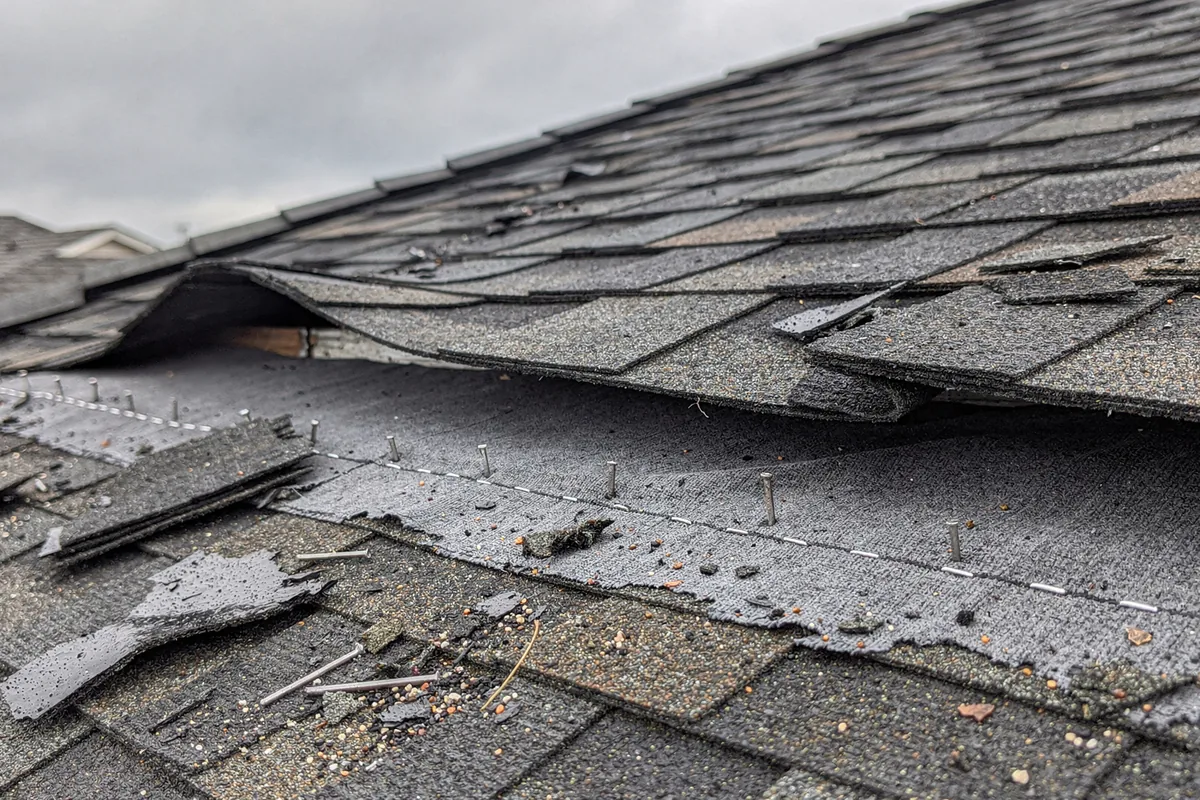
Fasteners placed above the strip that seals each course, which leaves every shingle relying on the nail alone. Fasteners driven hard enough to cut through. A starter course that was left out or reversed, which removes the seal along the single most exposed line on the whole roof. Valleys cut at speed. Flashing at a wall nailed through its face instead of being woven into the courses.
What matters about that list is that none of those faults happens once. Whoever did it did it everywhere, so finding one at a single detail is a reason to look at the others before deciding between a repair and a replacement.
Inland does not mean sheltered
Being away from the water changes the exposure category and it does not change the fact that a storm crossing the coast is still a storm when it reaches here. What is different is the fetch: wind arriving over developed ground and trees has been broken up in a way that wind off open water has not, so the loads at the edges are lower than on the eastern shore.
That makes ordinary correct practice go further here than it does on the bay. Perimeter fastening, a real starter course, a proper drip edge detail. Not exotic, and it is what stands up.
Worth doing before the season rather than during it
A roof fitted well on an inland street will take a great deal, and the cheap time to improve it is while the covering is off for other reasons. What the FORTIFIED standard asks for explains where that money actually goes, and it is the same work whether or not you pursue a designation.
If weather has already been through, telling wind loss from impact damage is where to start, because the two are argued completely differently once a claim is open.
Questions people ask
- My roof is thirteen years old and already losing shingles. Should it be?
- Not from age. At that point the covering has plenty left, so something about how it went on is the likely explanation. The three that show up at this age are nails placed above the sealing strip, a starter course left off or laid the wrong way round, and step flashing at a wall that was face nailed rather than woven in. Each produces losses in lines rather than scattered.
- Several houses on my road have had roofs done. Should mine be looked at?
- Yes. Same age, same product, same weather, often the same crew. That is about as close to a controlled comparison as a homeowner ever gets, and it is a reasonable thing to say out loud when you ask for your own roof to be inspected.
Last checked 2026-09-28.